Heating Oil: How Much You’ll Burn in a Day

Prime heating oil season is just around the corner! Which means high usage is becoming the elephant in the room! Our last winter was brutal. We had a total of two major snowstorms and 54 total inches of snowfall in Danbury! We also saw a surge in the price of heating oil because of the war with Iran. At the time of writing, heating oil is sitting at $4.09 a gallon, while gasoline is sitting around $3.55 a gallon. But you might be asking yourself how much you’ll burn on a day-to-day basis. This is an important question to ask yourself, and the answer is good to know as well!
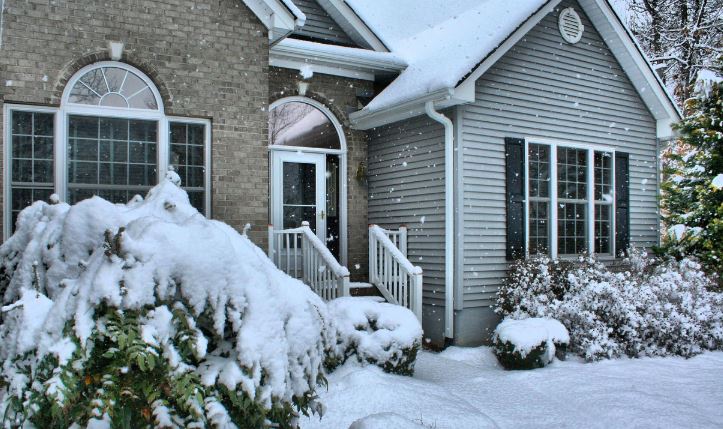
The winter brings peak heating oil season and high usage! You’ll often be burning more oil than you would during the summer!

How much you’ll be burning is different than what your family or neighbor might be burning. But I’ll be sure to break all that down for you! However, if you did run out of oil, you’re going to want to run to the gas station to get about 5-10 gallons of diesel. If you’ve got an oil delivery coming soon, then you’re going to want something to hold you over until you get your delivery. If you ran out of oil, you’re going to want to check out this blog post here.

The Biggest Contributors to Your Heating Oil Usage

There are a lot of things that contribute to your heating oil usage. However, some play a bigger part in it than others do. Below, I’ve compiled a list of all the major contributors to your heating oil usage and consumption.

  • Temperature Outside: The biggest and most important factor for high usage is the temperature outside. The colder it is, the more heat your home is going to try to produce. For example, you’ll likely be burning more oil when it’s 25 degrees out, compared to when it’s 50 degrees out!
  • Temperature Inside: While it might not seem like it, your home’s internal temperature will affect your heating oil usage. Ideally, the most comfortable setting for your home is usually around 70 degrees Fahrenheit. Setting the temperature higher, to say 80 degrees, puts more pressure on the system, causing it to try to produce more heat. This’ll ultimately result in more oil consumption.
  • Home Size: Your home’s size plays a crucial role in your daily consumption. The larger your home is, the more space that the system needs to heat. With more space, there is higher consumption. If your home is only a single-floor house, then it’ll burn much less oil than a home that’s two floors. The same can be said for a smaller home versus a larger home.
  • Good Insulation: If your home is well insulated, then you won’t have to worry too much about high usage! Your home’s insulation will determine how well it can maintain the heat your system produces. If your house is very well insulated, then you’ll likely have lower usage. But if your insulation isn’t up to date, then you might have higher usage. Your home’s insulation will determine how well you can keep heat in the home!
  • System Age: The age of your system definitely plays a role in its efficiency. If your system is newer, then it’s going to have good efficiency. Systems that are older than 30 years tend to be less efficient than newer systems. A brand new furnace tends to be well worth the money in the long-term.
  • What You Use Heating Oil For: What you use your heating oil for will affect how much oil you use. For example, if you’re using heating oil for just hot water and have propane or electric heat, then your usage will be significantly lower than someone who uses heating oil for both heat and hot water. Using heating oil for heat and hot water will, unfortunately, cause you to burn much more oil than if you’re using it for just one or the other.

Impact of Outside Temperature and Size of the Home

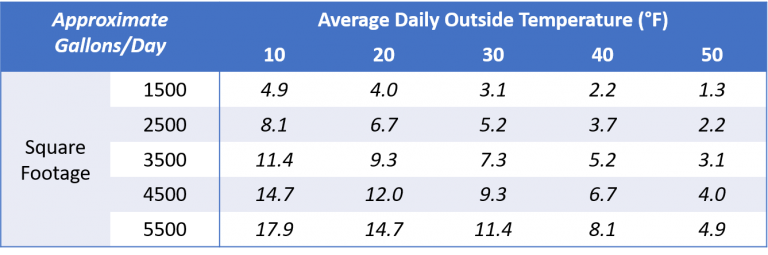
I briefly mentioned these above, but they’re so important for usage data that I figured I’d go a bit more in-depth. The size of your home and the temperature outside are probably the most important factors for consumption. The graph below gives you a combined average of usage based on square footage and outside temperatures. While yours might be different, you can get a general idea of how much oil you’ll be burning. But if the temperature is colder outside, you might see yourself burning a little bit more. The same can be said about having good insulation. If you’ve got good insulation, your home will burn much less oil.
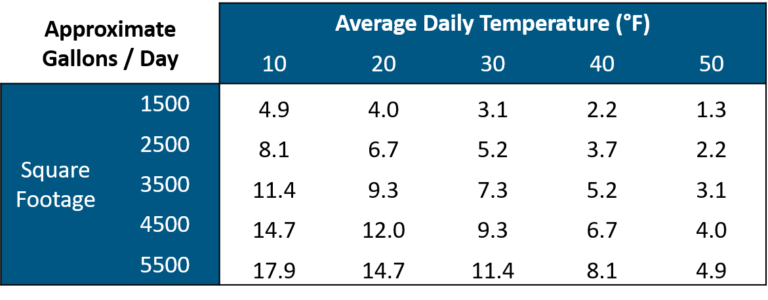
During the winter in the Northeast, you’ll burn 5-7 gallons of oil on average. But this is just the average. This isn’t always the exact amount you’ll end up burning during the winter. Each winter is different and results in different usage data!

Now, let’s figure in the size of your tank. Most homes in the Northeast have a 275-gallon tank. Whether or not that’s a Granby or Roth tank, it’s going to be roughly the same. On all tanks, the top couple of inches are left open for airflow. So on both tanks, your true capacity is 250 gallons. If we calculate a full tank with an average usage of 7 gallons per day, that’s roughly 38 days before your tank goes empty! That’s a little bit over a month! This is why it’s so important to find out how much oil you’re burning daily! When your tank gets to about a quarter, you’re going to want to order a fill-up!

Annual Heating Oil Usage

A large majority of those in the Northeast will only use heating oil during the winter. During the summer, your system will most likely be turned off. However, if you use heating oil for hot water as well, then you’ll have some very minor usage during this time! But this only tends to equate to less than a gallon of oil per day.
However, as you probably know, wintertime sees a massive spike in usage. As mentioned previously, the home size and outside temperature will be the primary factors in this. While the outside temperature determines how high you turn your system up, the size of the home influences the amount of space your system tries to heat. During the winter, your system will absolutely be working harder than during the summer.

Tracking Your Consumption with a Smart Oil Gauge

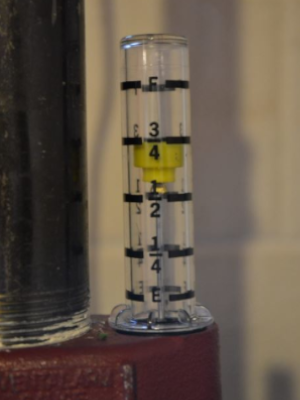
To better understand how much you’re using and when you should order, a Smart Oil Gauge is the perfect way to do that! All you need is a stable WIFI connection for the gauge to connect to. Then, once you set the gauge up, you’ll be able to keep track of your usage through our app. The gauge also gives you the added benefit of telling you how many days until you reach 1/2 tank and 1/4 tank. The gauge then uses these statistics to tell you when and how much oil you should order. The app also offers FuelSnap integration. This integration will allow you to use your Smart Oil Gauge to calculate how much oil you need to order and by when!
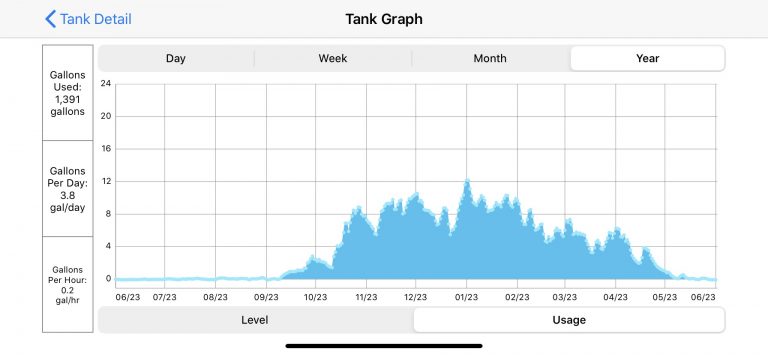
Yearly usage on the Smart Oil Gauge app will tend to look like this. You can see that from September until May, heating oil is used pretty often! December and January, you’ll tend to see peak usage!

The Graph in the app will show you level readings and usage data for daily, weekly, monthly, and yearly periods! However, the app only displays data from the previous year. If you want to export data from a previous year, you must log on to the website and export the data to a Microsoft Excel sheet!

Your Monthly Usage

Depending on how big your house is and how cold it is outside, you might burn an average of 5-10 gallons of fuel daily during the winter. Now, while many factors can make this more or less, they tend to vary. Insulation is big on keeping homes warm. But some homes might have poor insulation, which will result in high usage! But with tools like the Smart Oil Gauge and even your float gauge, you can easily track your usage and schedule a delivery within minutes! Plus, it’ll give you a better understanding of your daily usage!

Happy Heating!

Hunter
How Long Will Five Gallons of Heating Oil Last?

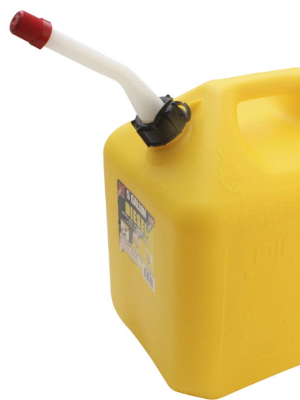
diesel can

During the colder months, you’ll know how important heating oil is. It has a variety of different uses. But, the most common use is for heating your home. You will need to purchase heating oil. But this begs the question, “How long will 5 gallons of heating oil last me?”

If you are running low on oil, stopping at your nearby gas station and buying a few gallons of diesel is a good temporary alternative until you get your delivery. However, this should be done sparingly because diesel is not a permenant solution.

There are a lot of different variables that can determine the answer to that question. During the winter months, 5 gallons of heating oil might not even last you a day. While during the summer, 5 gallons of oil, could last you a few days. It’s still important to ask yourself the following questions to ensure that you do not run out of heating oil.

            What do you use heating oil for?

            What size house do you have?

            Does your home have proper insulation?

            Do you have any drafty areas of the house?

            How warm do you like to keep your house?

            What is the weather and temperature like outside?

            What’s the condition of your boiler?

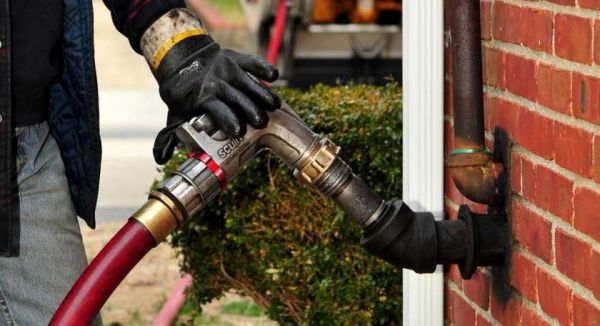
Home heating oil is delivered directly to a fill pipe on the side of a home.

Increasing Insulation

Insolation is a key factor in oil consumption. Insolation retains heat and keeps your house warm. Ensuring that your house has proper insolation, will help you get the most out of the heating oil you’ve purchased. With the correct amount of insolation, you’ll be able to maintain the heat that your boiler is producing for longer, reducing oil consumption.

Seal Up Drafty Windows to Reduce Oil Consumption

It might sound odd, but the types of windows that you have can affect your oil consumption. When your boiler burns oil, heat will spread throughout your house. As the heat spreads throughout the house, it will escape through the drafty windows. As a result, you will start to burn more oil. This can lead to higher-than-normal oil consumption which will quickly deplete the oil in your tank. However, if you have newer double-paned windows, the air becomes trapped between the two panes of glass. This is similar to insulation and will prevent the heat from escaping.

While that is a great solution, it isn’t cheap to replace windows. Using a thin plastic sheet, is a great way to seal up drafty windows. Apply the sheets to the window with double sided tame to make sure that they’re tight and secured. After the sheets are in place, go over it with a hairdryer to clean up any wrinkles. This will allow for another layer of insulation.

Heating oil consumption depends on outside temperature. A 2500 square foot home will use approximately 4-7 gallons per day on a typical winter day in New England.

Heating Your Home With Heating Oil

During the colder months of the year, where heating oil is most sought after, you will often be burning more oil than you would during the warmer months. This is because, as you are heating your house, the cold air outside is continuously drawing the heat outside through your walls. When this happens, your boiler will work harder to keep the house warm. This often results in an increased consumption of oil.

When heating up your home, your daily consumption will change depending on both the size of your home, as well as the outside temperature. During a warmer day during winter, you might at most use only around 2 gallons. While during the summer months, you might be even using less than half a gallon a day!

How Does Outside Temperature Affect My Heating Oil Usage?

In the state of Connecticut, the outside temperature can average anywhere from 30-35 degrees Fahrenheit. For the average sized home of 2000 square feet, the average consumption of oil is anywhere from 5-6 gallons of heating oil daily. Outside temperature is a huge contributor for increased oil consumption. It greatly impacts how much oil you are burning on a daily basis.

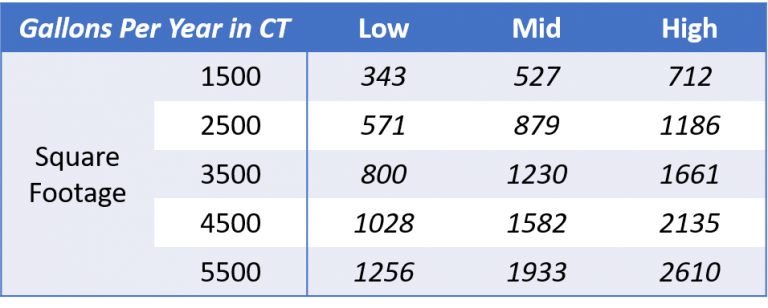
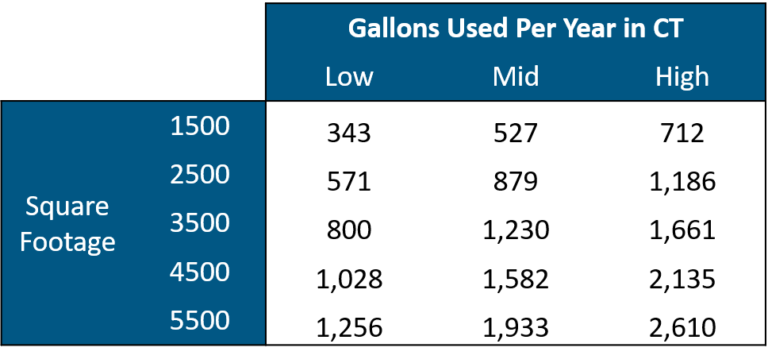
The typical house in CT will use about 880 gallons of heating oil per year.

Your graph will look different if you have an alternative form of heating. If you do, it is possible that you will be burning less oil and have a lower than the average home. But that begs the question, “How much oil am I burning in a year?”. Similar to the graph above, we have created a graph of estimated gallons burned per year in the state of Connecticut.

Program Your Thermostat to Reduce Oil Consumption

During the winter months, you’ve most likely heard your parents tell you, “Don’t touch the thermostat!”. The average home can get away with setting their thermostat to around 70 degrees Fahrenheit. This should be a decent temperature to remain comfortable in your home without needing to adjust the temperature of your thermostat.

You may be asking yourselves “Should I leave the heat on while I am not home?”. This could greatly effect the amount of oil you’re burning if you decide to do so. If you have a boiler with radiators in your house, then it can take some time for the temperature in the house to raise several degrees. By doing so, you might actually burn more oil at the end of the day, if you decide to keep your heat on when you aren’t home. However, your home might a have a furnace with air ducts scattered around the house. That is an example of “Forced Hot Air”. If you have any pets at home, you will likely want to keep the heat on, to keep them warm.

If you own a Smart Oil Gauge, you will be able to keep an eye on your hourly oil usage while you are not home. It is a fantastic tool that will help notify you if your usage is too high. This applies the same if you are home and just want to monitor your usage to see if you’re burning an excess amount of oil.

Maintaining a constant supply of heating oil means staying warm on cold winter days.

Is Your Boiler, Burner or Furnace Running in Top Shape?

A well insulated home won’t do you any good if your furnace isn’t running properly. It is very important that you have your system checked and adjusted to ensure that it is running as efficiently as it can. An average oil burner will last around 30 years, sometimes even more. As the years go by and the systems get older, you might end up using more oil than the previous year if not properly maintained. Even buying a new heating oil system can help decrease the amount of oil you are burning. However, we recommend getting your .


Every bit of information we have provided should provide you with a good idea of how long 5 gallons of heating oil will last you. But, the best way to see how long it will last you is to accurately measure it! The best way to do that is with the Smart Oil Gauge! The Smart Oil Gauge will send soundwaves down to the oil level that then bounce off of the oil’s surface and back up to the sensor! This ensures precise accuracy on what your oil level is sitting at, at the current moment! You’ll even be able to check oil consumption by day, week, month and year! In the photo below, you can see what the average usage will look like during the winter and during the summer!

A Smart Oil Gauge will allow you to closely monitor your heating oil consumption throughout the day.

The Smart Oil Gauge will be a worthwhile investment to keep track of how much oil you have and to ensure that you are getting the most out of your heating oil! It will also help to make sure that you will not run out of oil or get low on oil so that you won’t run out of oil! The gauge will also help you see the changes you’ve made using the tips described in this article.

Happy Heating,

Hunter