
Knowing what type of heating oil tank you have is important! The capacity helps determine how much oil you’ll have in the tank at any given time. It’ll also help you better understand how long your tank will last you. Typically, tanks have a plaque or a label on the side of them. This will tell you a few things about the tank, but primarily, it’ll tell you the manufacturer and the capacity of the tank. However, other than how much oil the tank can hold, the capacity and type of tank give us some important information about other aspects of the tank. Below, you’ll find everything you need to know about the capacities and what other secrets that they tell us!
Standard Steel Tanks
The most common tank sizes for steel tanks tend to be oval-shaped 275 & 330 gallon tanks. These tanks can be in both horizontal and vertical styles. Sometimes, horizontal and vertical tanks can get mixed up with each other. So I’m going to explain how to tell if your tank is horizontal or vertical. This is important, as it can vastly change how much oil you have in the tank! If you have a Smart Oil Gauge, making sure you have the gauge set to the right tank size is crucial for its accuracy!
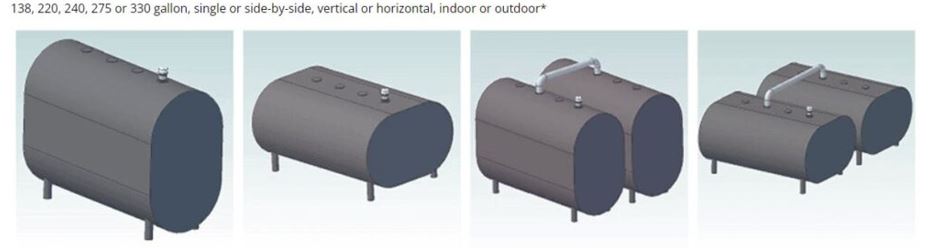
In the above picture, you’ll see various tanks. You can see both single-tank and double-tank setups. These are some of the most common tank setups in the Northeast. But you’ll notice that on both setups, some tanks are standing upright and the others are lying on their sides. Well, the best way to determine which is which is simple. I tend to look at it that horizontal tanks are flat on top like a table, but have rounded sides. You can see that with the above images of the horizontal tanks. They appear to be both flat on top and rounded on the sides. Meanwhile, the vertical tanks are rounded on top! If you look at the photo, you’ll see the vertical tanks have rounded tops but flat sides! Those are the best ways to remember which is which!
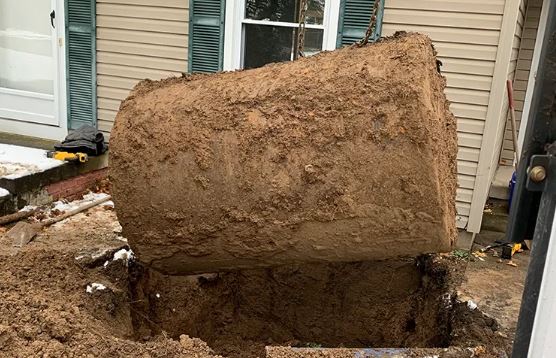
While relatively uncommon now, underground tanks are another type of steel heating oil tank to be aware of. These tanks tend to be 500-gallon cylindrical steel tanks. The only problem with these tanks is that they’re underground. These tanks are uncommon now because they are constantly being removed due to posing an environmental hazard as they get older.
Steel Tanks – Oil Capacity
All heating oil tanks have a maximum capacity and a true capacity. The maximum capacity of the tank is the max the tank will be able to fill. However, your heating oil tank should NEVER be filled to the maximum capacity. When delivering oil, drivers will fill up until they hear the whistle stop blowing. This tells the driver that it’s time to stop pumping oil into the tank. When they do this, they tend to leave the top 4-6 inches of the tank open for airflow. This prevents the tank from leaking or overflowing! If your tank is filled to the maximum capacity, then you should see about getting it drained a little bit! Filling to the maximum capacity can put the tank at risk of leaking or overflowing!
On a 275-gallon tank, the maximum capacity is 275 gallons. But the true capacity tends to be around 250 gallons. This is when the whistle stops blowing. For a 330-gallon tank, the maximum capacity is 330 gallons, while the true capacity is around 315 gallons.
However, with underground tanks, this is completely different. Because the tank is underground, there’s no whistle/vent alarm. So when filling the tank, the driver has to be extra cautious. You might see them fill the tank for a few seconds before stopping and putting a yardstick in the tank. This helps them get an idea of how much oil is in the tank, so they know when to stop filling. On a 500-gallon underground tank, the true capacity is 500, but the max capacity is likely between 450 and 475, as there’s no set-in-stone way for the driver to determine when it’s time to stop pumping!
Roth Double Wall Tanks
Now, Roth tanks are a little different. These tanks are actually two tanks in one! The outside looks like a big steel rectangle. However, on the inside, there’s a slightly smaller plastic tank. That plastic tank is where the oil sits in the heating oil tank itself. The exterior steel tank is actually an extra form of protection in case the inner tank fails. The outer steel tank will catch any oil that escapes the innermost tank!
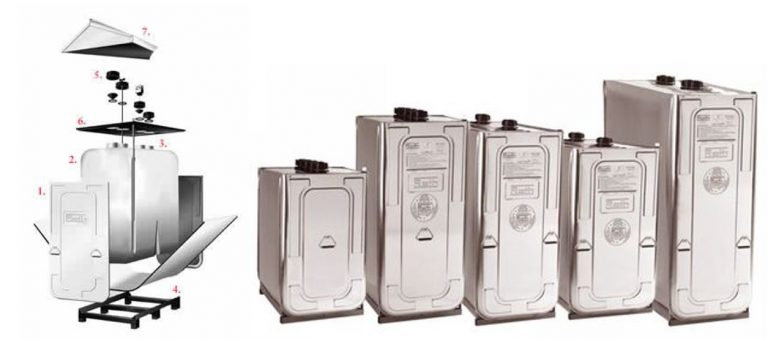
As you can see in the above picture, there are a few different capacities for these Roth tanks. Typically, they range from 110 gallons up to 400-gallon tanks. However, note that if you have a Smart Oil Gauge, it’s not compatible with the Roth 1500L because of an interior support baffle on the inside of the tank that’ll prevent the Smart Oil Gauge from reading beyond half a tank.
Roth Tank – Oil Capacity
Similar to steel tanks, the Roth tanks will usually have the top couple of inches left open. Like the steel tanks, the top couple of inches are usually left open for airflow. But on Roth tanks, these tend to be much smaller. For example, the max capacity of a Roth 275-gallon tank is roughly 260 gallons. This is because the tanks are a little bit taller, so it evens out, and you’re usually able to fit slightly more in the tank than in a 275-gallon steel tank. That being said, the driver is still only going to fill the tank until they hear the whistle stop!
As I mentioned in the previous section, Roth tanks have a variety of different sizes and styles. This gives you a bit more options for the max capacities of the tank. You can have multiple Roth tanks installed beside each other. But they must be the same size and capacity. However, that’s few and far between. The different types of Roth tanks are listed below with their models and gallon amounts. Usually, you’ll find a sticker on the back or side of the tank with the model and gallon amount.
- Roth 400L – 110 Gallons
- Roth 620L – 165 Gallons
- Roth 1000L – 275 Gallons
- Roth 1000LH – 275 Gallons but with a shorter tank
- Roth 1500L – 400 Gallons
Non-Standard Tank Sizes
Standard steel oil tanks and Roth tanks are the most common tank sizes in the Northeast. However, non-standard tanks can be a little tricky. Normally, these tanks will also have a plaque or label on the sides of the tanks. They’ll tell you the capacities of the tank and the manufacturer, like normal. However, the maximum and true capacities of the tanks vary. These tanks often have many varying sizes, so the true and max capacities aren’t as easily calculated. The best way to get an idea of what your true capacity is is to use a tank calculator. Simply get the dimensions of the tank and plug them into our tank calculator! Our calculator will be able to tell you how much oil can fit in your tank after you plug in the dimensions! You can find it here.
Determining Your Tank
Finding out what kind of heating oil tank you have is easy! Simply go over to the side of your tank and look for the label or plaque that’s on the side of the tank. That will typically tell you your tank size and capacity! But if you don’t see it, you can simply get the dimensions of the tank and plug them into a tank calculator. You can get the tank’s capacity from there!
However, knowing what tank you have is important to be able to track your usage and get an idea of how much oil you have left in the tank! Doing this will help you keep better track of your usage and oil level, especially if you have a Smart Oil Gauge! Knowing your tank size is crucial for the gauge’s accuracy!
Happy Heating!
Hunter