Heating Oil Vs Propane: What You Should Know

In the Northeast United States, heating options are quite limited. However, natural gas is increasing in popularity. It’s cost-effective and reliable, making it an excellent choice to heat with! However, unlike the two titans of the industry, Heating Oil and Propane, it can’t be installed in a pre-existing home or neighborhood. This makes it unavailable to most of the general public.

But in small apartments, condos, and places with mild winters, you’ll see electric heat and heat pumps being more common. Electric heat can be expensive, but in places where winters are milder or with smaller spaces, it won’t be as bad. Otherwise, your options are left to Heating Oil and Propane.

Heating oil and Propane are the most popular forms of heating across the East Coast. They’re both fuels that get delivered to your home in a liquid state before it’s converted to heat and pushed throughout your home. Despite these two having some similarities, there are some differences. But what are they exactly? I’ll be covering exactly what you need to know below!

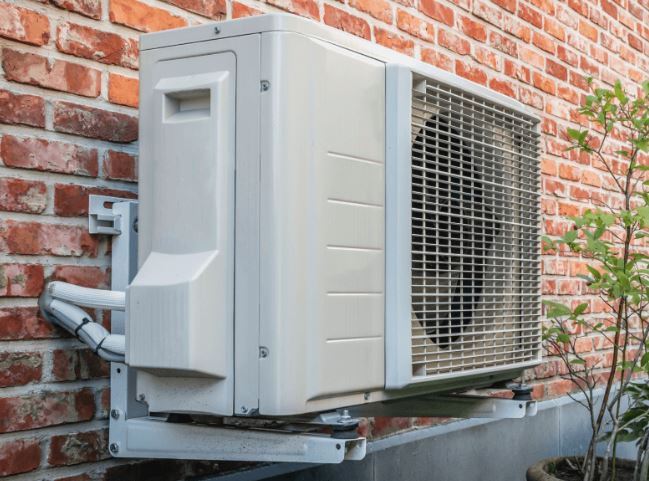
Outdoor heat pumps look like this! They’re increasing in popularity and are cost-effective!

Switching: When you Should Make it

When it comes to making the switch to either Heating Oil or Propane, it boils down to when your home needs a new boiler or furnace. The most expensive component tends to be the system. When changing out your current system for the other, here are some things that you’ll need to know.

  • Tank: The tank is the most important component of your system. Regardless of whether you own it or are renting it, you should know where it is and what its capacity is.
  • BTUs per Gallon and System Efficiency: Knowing the difference between the two fuels, BTUs and System Efficiency, is important for functionality. For example, propane tends to be more efficient. However, it produces fewer BTUs per gallon than heating oil.
  • Shopping Flexibility: If you like to be in control of when you receive your delivery, then this is important. You don’t want to run out while waiting for a delivery!

What are the Differences?

The biggest difference between the two types of tanks is the cost. Propane tanks are often much more expensive than heating oil tanks if you buy them outright. At the time of writing, you can buy a standard heating oil tank at Home Depot for around $1k, depending on the model. However, propane tanks tend to be a bit pricier at $1.5k for an average tank. While the prices are similar, a heating oil tank is the cheaper option.

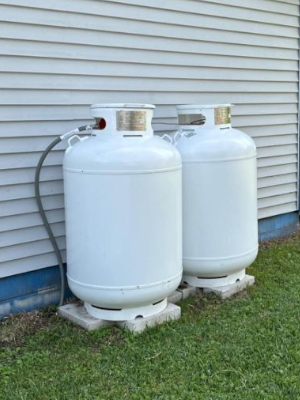
How they’re stored is another major difference. Heating oil tanks can be placed indoors or outdoors. They also tend to be more compact, preventing them from taking up a lot of room. However, propane tanks tend to be big and bulky. Plus, if you’re renting them, then you’re required to have them installed above ground, outside. But if you own them, you can install them underground without posing a threat to the environment.

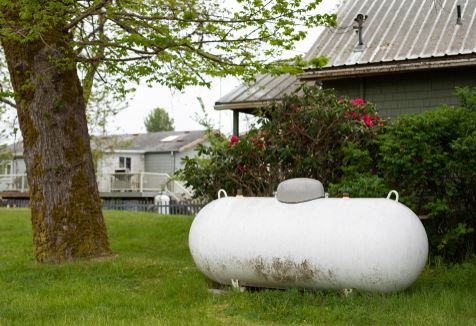
Propane tanks will tend to look like this. They’re installed above ground outside if they’re rented by an oil company.

The Owner of the Tank

Tank ownership is a big part of owning a heating oil or propane tank. When it comes to heating oil, you’ll typically own your tank. Meanwhile, with propane, the provider tends to own it. This means that they’re in control of when you get a delivery!

When making the switch from heating oil to propane, the provider will tell you that it’ll save you money, but that’s just not true! Renting the tank from the provider will prevent you from ordering from anyone else! You’ll have no freedom when it comes to ordering! In most states, it’s illegal to fill another provider’s tank. This means in an emergency situation, you won’t be able to order from someone else if you need to! If you want to change providers, you’ll either have to buy out your tank, buy your own, or contact another provider to put their tank in!

However, when it comes to heating oil, you’ll always own your tank! You can buy it directly from the manufacturer or a storefront such as Home Depot or Lowe’s. But you get the added benefit of having the freedom to order from whoever you want! So it’s best to own your tank regardless of whether you heat with heating oil or propane!

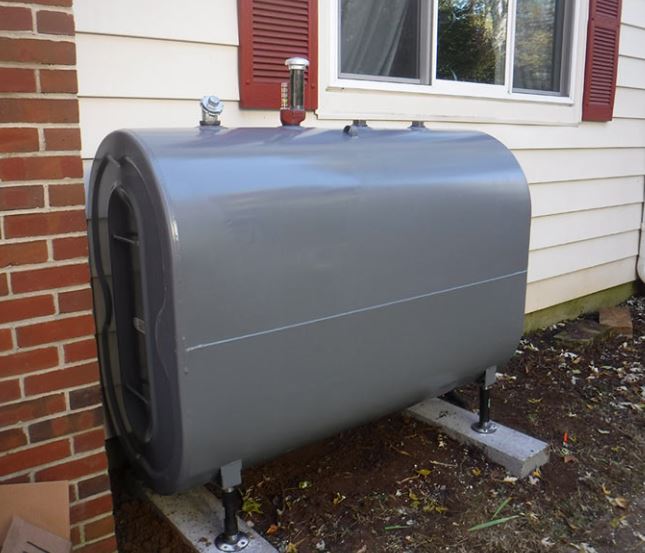
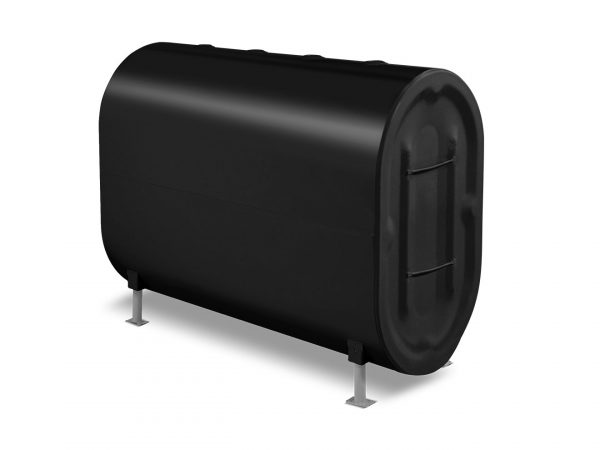
Standard oil tanks will look like this. Typically mounted on the side of the house, in the basement, or in the garage.

Which is More Efficient?

With how current prices are for heating oil, it might seem that propane is the better option to go with. However, just by looking at the price per gallon, you’re omitting two of the most important factors. These factors are BTUs (British Thermal Units) and Efficiency. BTUs determine how much heat is produced by a gallon of the desired fuel. For example, heating oil produces 138,000 BTUs per gallon! However, propane will only produce 91,000 BTUs per gallon. That is significantly less than what heating oil produces!

While BTUs are a major factor when it comes to heating, efficiency is important as well. Most modern-day boilers and furnaces tend to be 95% more efficient when compared to older furnaces. Propane furnaces will convert 95% of the propane into heat. Meanwhile, heating oil will only produce 85-90% heat from the boiler/furnace. Using 85% in our calculation below, we’ll get the following:

Propane: 91,000 x .85 = 77,350 Effective BTUs per gallon

Heating Oil: 117,300 x .85 = 117,300 BTUs per gallon

If we’re doing a comparison side by side, you’ll want to take a look at how many gallons of propane it takes to produce the same amount of heat as heating oil. This will be based on one gallon of heating oil. Heating oil produces 117, 300 effective BTUs per gallon, while propane only produces 77,350 effective BTUs per gallon. Using the following, you’ll be able to determine how many gallons of propane it takes to produce the same amount of BTUs as a gallon of heating oil.

117,300 / 77,350 =1.51 gallons of propane

As you can see, heating oil produces more BTUs per gallon than one gallon of propane! You’ll need a gallon and a half of propane to match the amount of heat that Heating Oil Produces!

Flexibility to Order From Who You Want

The nice thing about heating oil is that you have the freedom to order from whom and where you want to. Signing up for automatic delivery is a start. However, note that when you sign up for automatic delivery, you’ll end up paying a premium price per gallon. Call-by is much better in terms of placing orders. There are no hidden fees, and using reliable websites such as FuelSnap, you’ll end up getting some great prices!

Price shopping when it comes to propane is VERY hard. This is because most of the time, a propane tank is going to be rented from the provider. There’s a small percentage of propane tank owners who own their tanks. If you’re one of them, congratulations! But unfortunately, you won’t be able to do much shopping around.

However, with heating oil, the market is much more competitive. Due to this, prices tend to be a bit more sporadic than with propane. Dealers are constantly competing with each other to get customers on their schedule, so it’s advantageous to have the best price in the area. This gets them more orders and more new customers! Heating Oil tanks also get the bonus of utilizing the Smart Oil Gauge!

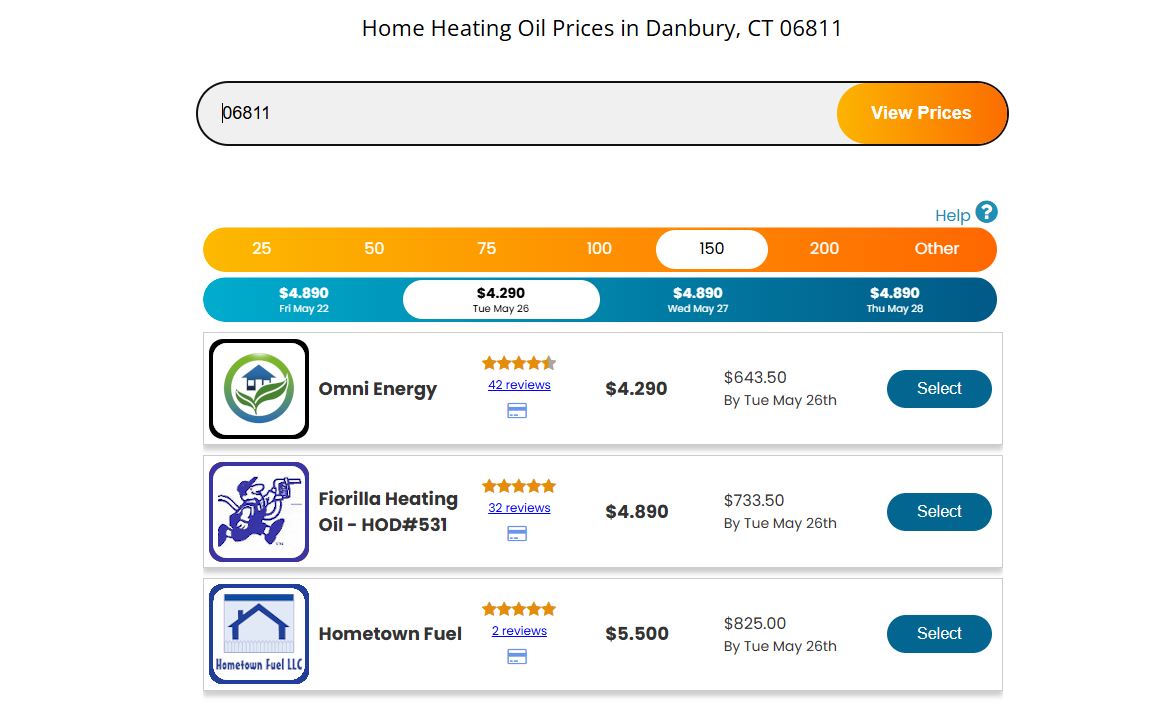
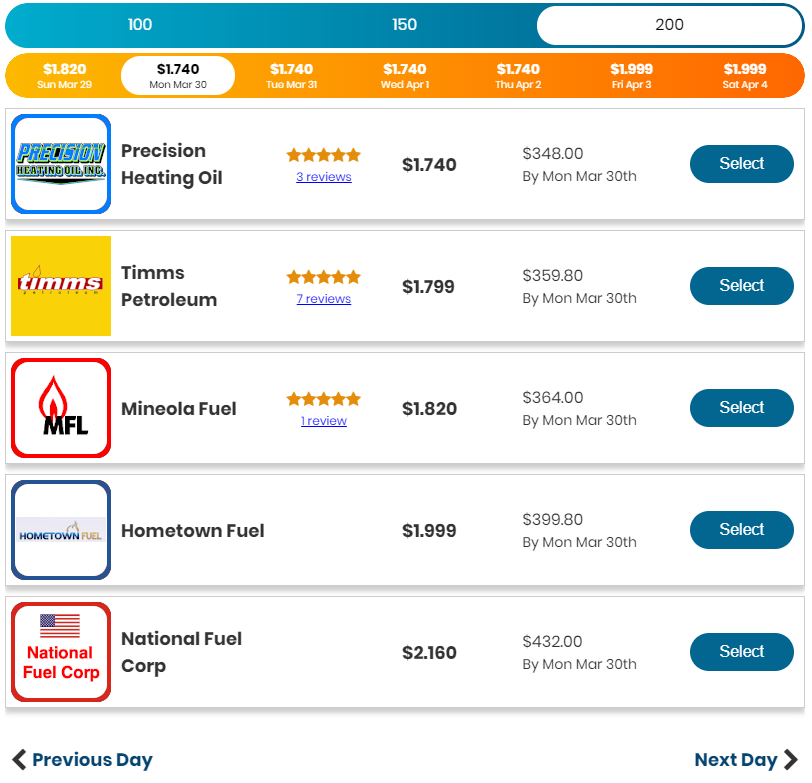
At the time of writing, these are the current oil prices in Danbury.

The Bottom Line

When it comes to which is better, heating oil is the clear answer. It burns much hotter, and you own your tank, which makes shopping around a breeze! Plus, with cheaper tanks and competitive pricing, you’ll be able to get a fill-up for a good price and not be restricted by the dealer!

However, that’s not to say that propane is without its merits. It’s versatile and is often used for more than just heating! If you find yourself needing to use propane for cooking, electric, and more, then this is your answer! Just be aware that you’ll likely have to rent from your provider!

At the end of the day, which you choose to use to heat with is up to you. They both have their positives and negatives and will both provide you with ample warmth and will be effective long-term heating solutions.

Happy Heating!

Hunter

How to Avoid Running Out of Oil

With the heating oil season just over the horizon, it’s important to keep in mind how much oil you’ll use during the winter. But it’s also a good idea to start checking heating oil prices regularly! At the time of writing, oil prices have spiked due to the war with Iran! Heating Oil is at about $4.25- $4.50 per gallon! This is due to the price of crude oil, and it’s incredibly expensive to fill up a tank with oil! Especially with prices where they are now, it’s crucial to be on top of your usage and keep track of your oil level! So the question stands: “How do I avoid running out of oil? Well, don’t worry, I’ll be answering all the important questions below!

Filling up regularly will help prevent runout! The last thing you want is to wake up to a cold house!

Heating Oil Tank Capacity

The maximum capacity of a standard heating oil tank is around 275-330 gallons. But it’s a good thing to know that these tanks will rarely be filled to their true capacity. The reason for this is that dealers will fill up until the whistle stops. This’ll actually make the true capacity different. On a 275, it will be 250 gallons, while on a 330, it’ll be around 315 gallons. Your capacity will have some effect on how much and how frequently you order oil. Ideally, you’ll want to order oil when your tank gets to a quarter. On a 275-gallon tank, this is around the 75-gallon mark, while on a 330-gallon tank, it’s closer to 95 gallons.

You should NEVER let your tank’s oil level get below 1/8. The reason for this is that this is around the time your system might start to catch sludge. On Roth tanks, this isn’t a problem. However, on standard steel tanks, sludge can be sucked into the feedlines. When this happens, your lines will get clogged, which will cause the system to shut down, resulting in no heat! On a 275-gallon tank, the 1/8 mark is about 35 gallons. But if your tank’s feed lines are top-fed, then this will be the point at which you run out of accessible oil.

What Happens When You Run Out?

When you’re running out of oil, the first thing that’ll happen is that you’ll have no heat. No heat means waking up to a cold home, which isn’t a fun experience! However, it’s important to note that waking up to a cold home doesn’t always mean you’re out of oil. It could mean that there’s a faulty part in the boiler/furnace or the feed lines are clogged! It’s always good to check! One time, my boiler’s starter wasn’t working properly! We had heating oil, but the starter wasn’t working, so my family and I were freezing!

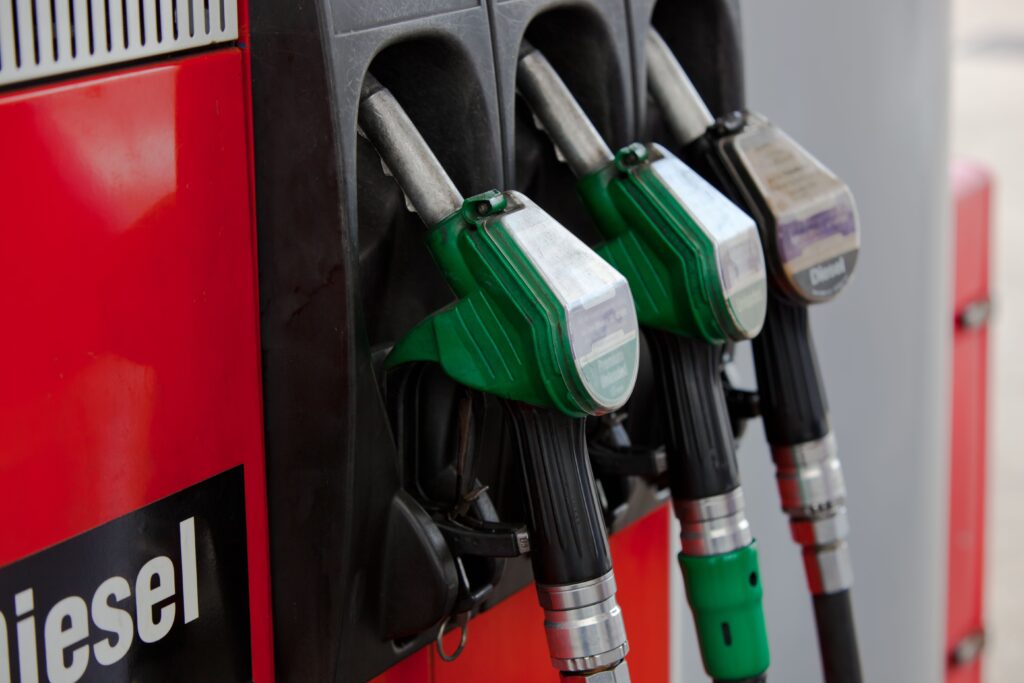
When you run out of oil, you’ll want to run and grab some diesel. This’ll hold you over until your delivery of oil arrives.

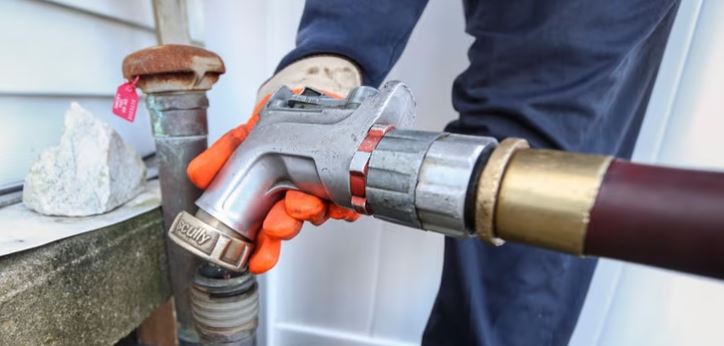
If you’ve run out of oil, the very first thing you should do is contact a local oil dealer to place an order! Try to see if they can put you in for an emergency delivery. Once you’ve placed the order, go to the gas station and get about 5-10 gallons of diesel. This should hold you over until your delivery arrives. If you need the step-by-step guide to this, you can check out what to do here.

How Long Will a Full-Tank Last?

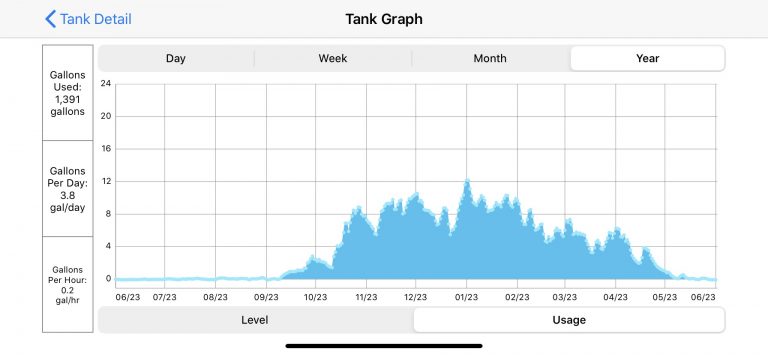
If you know what size your tank is, then you’ve got a baseline. You’re going to have an easier time figuring out how much a full tank of oil will last you. However, a Smart Oil Gauge will make the process of finding this out much easier for you! In my articles on Spring and Winter usage, I calculate specifics on how much you’ll expect to burn if you’re interested!

However, if you haven’t guessed by now, winter sees the most heating oil usage by far! Primarily due to the cold weather outside, you’ll find yourself burning around 5-7 gallons a day! Sometimes even more if you have a large house and use it for both heat and hot water. You might see yourself ordering oil more frequently during this time! Typically, you’ll need to order oil every month or so, depending on how much you’re using.

But on the flip side, during the spring and summer months, you’ll end up using significantly less oil! During this time of year, oil usage is going to be at a low. So you might only see yourself burning less than a gallon a day. Running out of oil is very unlikely during this time. But even so, don’t let your guard down!

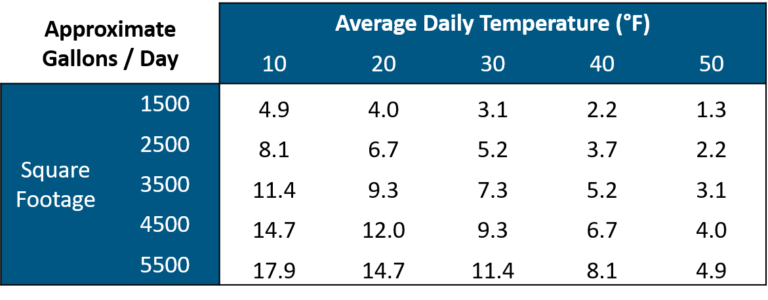
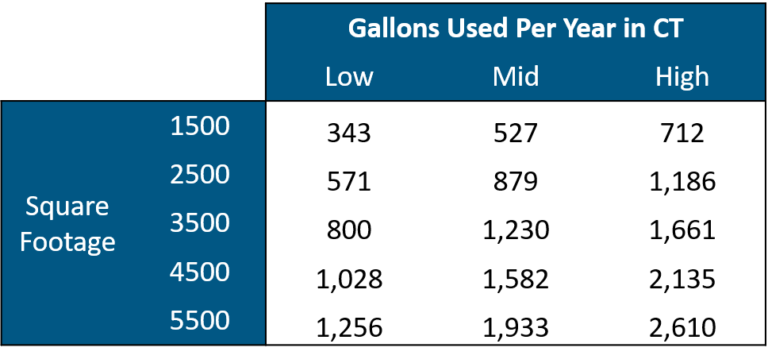
Your average daily usage is going to be different depending on the size of your home and what the temperature outside is.

Final Thoughts

Avoiding running out of oil is fairly easy. So long as you’re on top of your heating oil usage and tank level. Make sure that when your tank starts to get low, you order at a quarter tank. This gives you enough time to get the delivery before you run out! You can use a website like our FuelSnap website to get the best prices on heating oil in your area! With the combined use of the Smart Oil Gauge and FuelSnap, you’ll get a leg up on other homeowners!

Making sure that you’re on top of your level and usage is crucial to make sure you’ve got oil in your tank. Keeping an eye on this will prevent you from running out as long as you’re on top of it!

Happy Heating!

Hunter

Preparing Yourself for Heating Oil Season

If you’ve watched Game of Thrones, you’ll know the iconic phrase “Winter is Coming”. Well, it’s August now, which means Heating Oil Season and Winter are just around the corner! Just like in the show, it’s important to understand that in the Northeast, it’s bad not to be prepared for what’s to come. Winter is peak season for heating oil, and now that it’s August, there’s a lot for you to do before winter is in full swing! Like every winter, you shouldn’t go in unprepared!

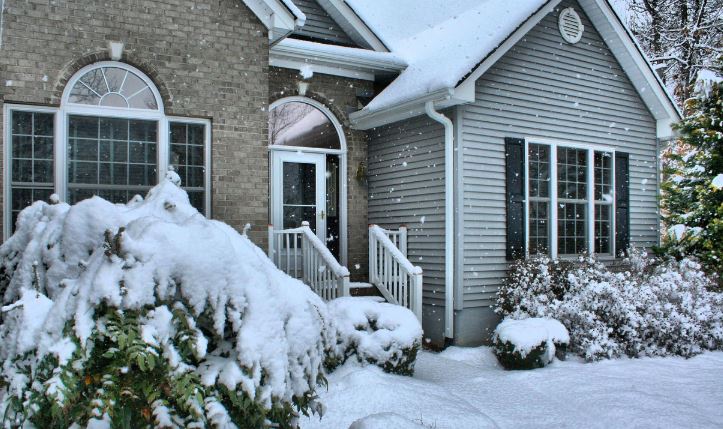
Fall and Winter are just around the corner! Which means soon your home will look like this!

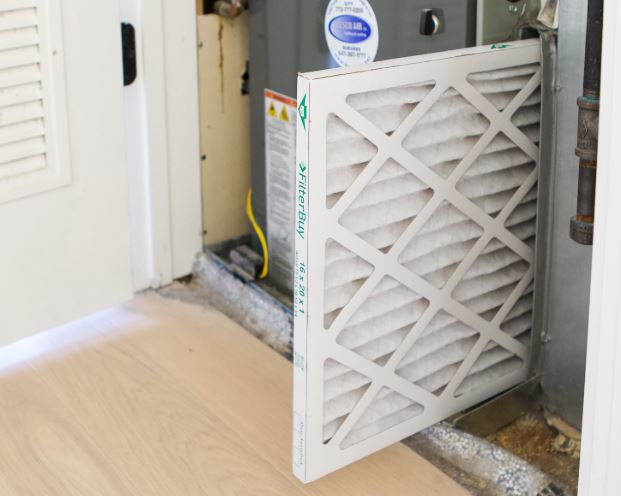
Changing Out Your Air Filters

Forced air is an increasingly popular form of heating. If you use this, then now is the best time for you to change out your air filters. Ideally, these should be changed out every couple of months! However, if you have pets, then these should be changed out more frequently! But during the summer months, especially, they’ll get much dirtier. This is often due to collecting allergens, pet hair, dust, and dander! Changing out these filters is crucial to maintaining a healthy home, especially if you live with people who have allergies!

However, what’s the process for changing them? If you follow the steps below, you’ll understand exactly what you have to do to replace them!

  1. The first thing you should do is turn off the furnace. This is crucial because your furnace might turn on if you’re changing out the filters! You don’t want that to happen!
  2. Then, you’ll want to remove the side door to the furnace to access the filters. After doing this, snap a quick picture of how they’re installed currently. This will help you make sure the new ones are installed correctly after you’ve taken the old filters out!
  3. Find out what size your filters are. If you haven’t done this before or are unsure as to what size filters you have, you’ll want to get this information. The most common size for these filters is 25x20x1. But if you don’t have any replacements, you can stop by the hardware store and pick up some.
  4. Once you have the replacement filters, you’ll need to replace them! The replacements should have arrows showing how they’re installed. Follow those so you can install them properly!
  5. You’re all set! Just close up the furnace door and turn it back on!
Changing out your filters is pretty easy! Just make sure you turn off your furnace when you do it!

Gathering Firewood

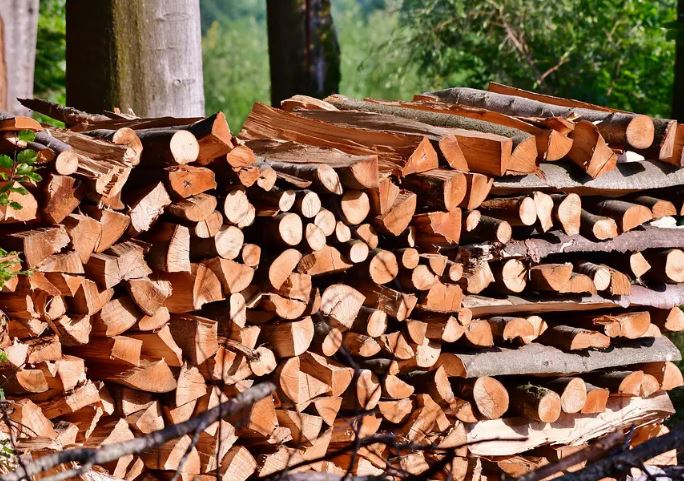
If you’ve got a fireplace or wood-burning stove at home, then you might know that you have to gather firewood. My family and I have a wood-burning stove, so typically we start to gather firewood around May-June. The earlier you gather it, the better, because it gives the wood time to try out before you burn it! But if you start stocking up now, then you’re still on the right track! Sometimes the cold weather doesn’t start until late September, early October anyway!

If you don’t have a lot of time to gather firewood on your own, then buying pre-cut wood is an option! However, it tends to be a little bit more expensive. You’ll be able to find them at places such as Home Depot, Lowe’s, Tractor Supply, and even some gas stations! But if you’re like my family and have been doing this for a while, you’ll have a log splitter! This speeds up the process of cutting up wood! Rather than relying on an axe. These machines streamline the process!

But if you have the time, gathering and splitting your own wood will save you so much money! Some woods, however, will tend to burn better than others. Oak, for example, is the most popular for burning. It’s not messy, and it takes some time to burn. However, pine is very sappy and can take a bit longer to dry out. Birch, on the other hand, burns quickly, and it doesn’t last very long. However, this makes it an excellent fire starter!

Stocking up on firewood is a great way to prepare your furnace and wood burning stove for the long winter ahead! This’ll also lower your heating oil usage if you have both!

Heating Oil Tank Inspection

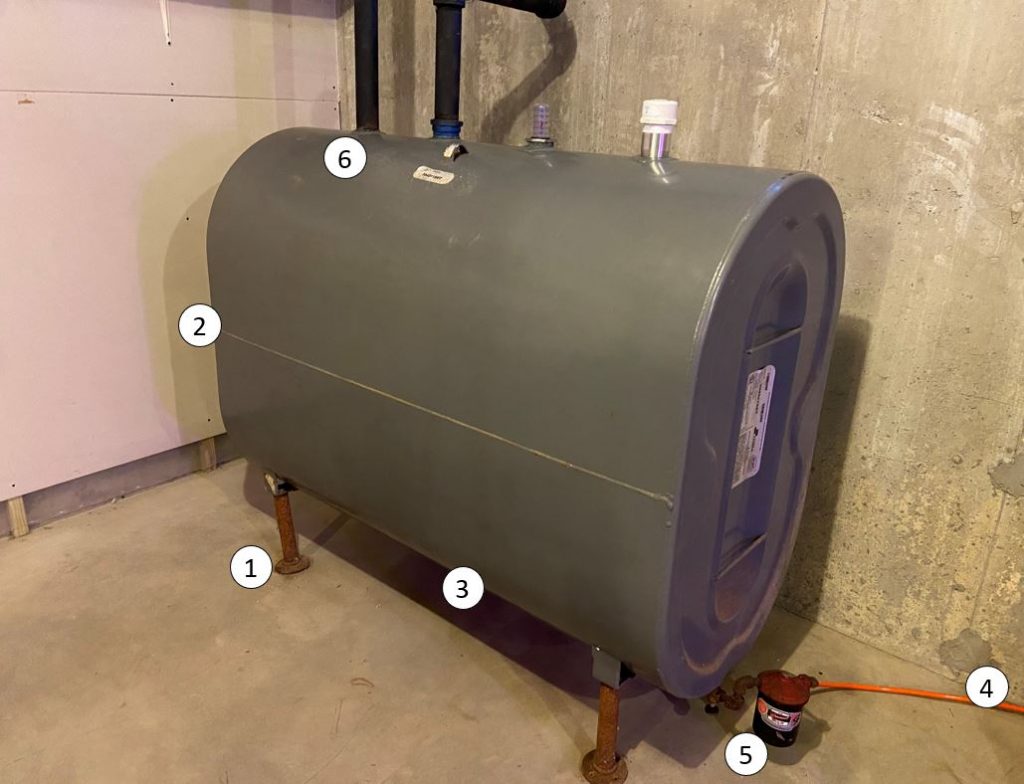
As the years go by, your heating oil tank will get older. This often makes it susceptible to general aging over time. The tank itself will experience wear and tear as it gets older. For this reason, regular tank inspections are important for your tank. While this process doesn’t take a long time, it’s crucial for your system’s functionality and your safety.

In this section, I’ll be covering a brief explanation of what’s involved in a tank inspection. But if you want a more in-depth explanation, check out this article here.

  1. Inspect the Legs to make sure that they’re sturdy. Also, make sure that there’s leaks in the tank.
  2. Make sure there’s no rust on the seams of the tank.
  3. Check the bottom and sides of the tank for any signs of leaking oil.
  4. Make sure that the oil lines have no leaks.
  5. Check the oil filter to ensure it’s not leaking.
  6. Check the top of the tank and fittings for any damage, rust, or cracks.
These are the key points you’ll need to look at when getting a tank inspection!

System Tune-Up

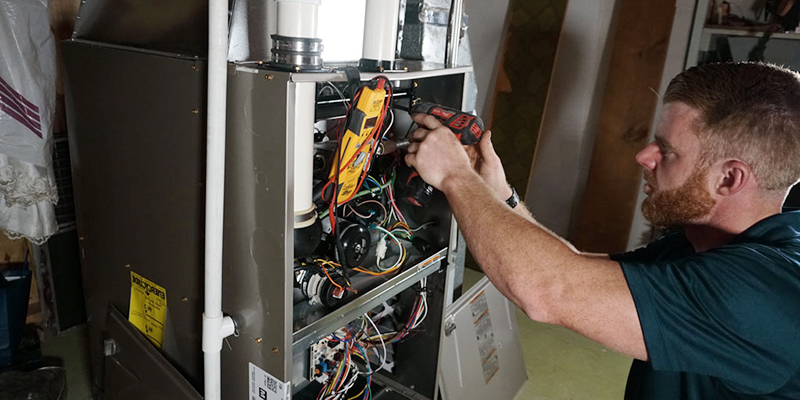
Annual system maintenance is important for your heating oil system to function as intended. Making sure your system is properly maintained is a requirement to ensure that the system itself doesn’t shut down when you need it. If it’s been a while since your last system service, or you need one, contact your local HVAC technician. They’ll be able to do all the required service and maintenance to make sure that your system is in tip-top shape! But keep in mind the price. Usually, system maintenance will cost around $300-$400 on average.

System tune-ups are crucial for your system. They ensure your system is working as it should!

However, when you contact your HVAC company, see if they offer a maintenance contract. These service/maintenance contracts will help you stay on top of your system’s maintenance. This’ll ensure that your system is in good shape for when you need it. Some HVAC companies will actually give you a discount when you sign up with them! It’s a good thing to ask!

Fill-Up Your Heating Oil Tank

Now that it’s getting to the end of summer, it’s a good time to fill your oil tank. Making sure that you have a full tank of oil will be very helpful when winter comes. Filling up your tank of heating oil will make sure your tank is ready to go when the temperatures start dropping! If you’re getting low now or are sitting at around half a tank, now’s a good time as any to order oil. It’s always a good idea to go into heating oil season with a full tank!

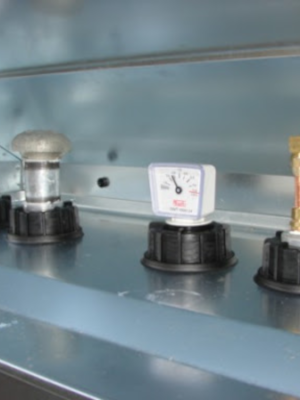
Your tank gauge is another important tool for you when it comes to monitoring heating oil usage and level. Most tanks come with a float gauge. However, the Smart Oil Gauge is another useful tool to track your data. You’ll have access to everything that you need at the touch of your fingers! You’ll even be able to order oil with our FuelSnap integration. FuelSnap lets you get the best selection of dealers and prices in your area!

Getting a fill-up now of all times is a great idea! This’ll make sure that you’re all ready for heating oil season!

Closing Thoughts

There are plenty of things that you need to do before heating oil season arrives. If you have the above-mentioned available to you, you’ll be fully prepared for the winter! Make sure you’re prepared when going into heating oil season and winter! You won’t want to be blind sided by a snowstorm or cold weather and not be prepared. If you’ve got a wood-burning stove or fireplace, stock up on firewood. If you’ve got a heating oil system, make sure that you get your tank filled and your system serviced!

As temperatures get lower and lower, we’re going to slowly start turning on our systems. Winter is around the corner, which means we’ll need to be warm for the cold months to come! Do not be un-prepared for what’s to come!

Happy Heating!

Hunter

How to Order Home Heating Oil | Buy Heating Oil with FuelSnap in CT

Ordering oil online.

Ordering home heating oil was once a truly daunting task. The fact that there are hundreds of home heating oil delivery companies to choose from is great. But choosing between them can be challenging to say the least. Ever try to Google “best oil company”? There are dozens of websites to choose from, making the choice quite difficult. You also need to consider how much heating oil to order and how to buy oil. If this is you, check out our blog post here on how much is in your tank.

When it comes to filling up, there are a variety of ways to order heating oil:

  • Automatic home heating oil delivery: old-fashioned, and expensive
  • Ordering fuel oil via phone: old-fashioned, and time consuming
  • Ordering heating oil online: quick, transparent, and secure

Automatic Home Heating Oil Delivery

This is the old way of ensuring you always had heating oil throughout winter. Automatic delivery means you sign a contract with a local oil delivery company. You give them ALL your business for the year, and they take care of scheduling deliveries at their convenience. So, in exchange for ALL your business, what do you get in return? You get to pay extra! How much are automatic delivery oil prices? Oil prices are, on average, $0.40 to $0.80 per gallon higher for automatic delivery customers. This adds up to hundreds of dollars extra every year, since most homes use 800 to 1000 gallons per season.

Before the internet, local oil companies convinced homeowners that there was tremendous value in automatic delivery. You would not have to run down to the tank to check the level periodically. Today, however, times have changed. With devices like the Smart Oil Gauge, you no longer need to remember to check the gauge. The Smart Oil Gauge gives you an app on your phone to tell you the level, and even alerts you when your home oil tank is low. This way you know exactly when the time is right to order heating oil.

With a Smart Oil Gauge, you can cut the cord, and start saving hundreds of dollars a year by discontinuing automatic delivery. When it’s time to fill up, you can choose from any heating oil company you’d like. Find a reputable dealer with a great price, and fill up on your own terms.

Worried about your heating oil service contract? If your oil company says you have to be on automatic delivery to receive a service contract, that should be a red flag. Check out this blog post on the truth about service contracts. You do not need to be on automatic delivery to receive a service contract.

Ordering Via Phone

Many home heating oil companies are a bit slow to evolve to the changing times. One of my favorite, long-standing local oil companies has no website. You have to call their phone number, press 1 to hear today’s oil price, then listen to a recording to find out the price. Then, if you want to actually order oil, you have to hang up, call back, and dial a different extension to place the order. Oh, and you don’t even get to talk to a human at this point. You have to leave a message on the answering machine and HOPE that someone received it and has scheduled your delivery.

At other home heating oil companies, you can call to order, and you end up on the phone with someone in the office. If this is the case, you’ll have to discuss payment options. Many companies will take a credit card over the phone. This is certainly more convenient than paying with cash or check. It also allows the final amount to be adjusted based on the amount delivered. With cash or a check, you’ll need to know the correct amount and meet the driver to pay for the delivery. In some cases, you may be able to mail a check in after the fact. This too, takes considerably more time than paying by credit card. You’ll want to know your options up front though, before placing the order.

Ordering heating oil by phone is cumbersome and requires calling multiple local oil dealers to compare prices. Be prepared to provide a credit card over the phone, or meet the driver with a check or cash when the delivery is made.

Ordering Heating Oil Online

By far the most convenient way to buy heating oil is online. Many modern home heating oil companies in CT have their own website, where you can create an account, and securely order heating oil online with a credit card. This is much more convenient than ordering by phone, but still does not allow you to price compare. If you Google “Connecticut heating oil prices”, a myriad of different websites will pop up. From anonymous sites that will not tell you what oil company you are ordering from, to every unique heating oil dealer’s website on its own.

Navigating through home heating oil companies online is cumbersome to say the least. With sites like FuelSnap, however, searching is easy. Find the cheapest home heating oil, and buy heating oil in seconds. Choose from real companies, with real-life user reviews before ordering. Choose the number of gallons and your delivery date to know when oil’s coming. Pay securely with a credit card, and know there will be no surprises when the truck comes. With a Smart Oil Gauge installed, you can order only what your tank will hold. You no longer have to estimate how much to order.

Using a heating oil site like FuelSnap, you can compare multiple heating oil dealers. You’ll know you’re getting the best price for heating oil, and are ordering from a trustworthy dealer.

What is the Best Way to Order Heating Oil?

Considering the options, the first question to answer is should I sign up for automatic delivery? Ten or twenty years ago we would have said yes. But today, with technology like the Smart Oil Gauge, you will save hundreds of dollars per year by NOT signing up for automatic delivery. You should always buy oil as needed, as this will ensure you are getting the best home heating oil price available at that time.

When your tank is low, it’s time to order heating oil. If your preferred oil company has a website, that may be a good place to start. However, you should always spot check other sites, or go to a marketplace site like FuelSnap, to make sure you are getting a good deal. The dealer with a great price at the beginning of the season may end up being much more expensive toward the end of the season.

Whatever you do, you’ll want to pay securely with a credit card online. Giving credit cards over the phone means the final charge is at the dealer’s discretion. When your card is charged up front, the dealer can refund you money for oil that was unable to fit in your tank, but the dealer cannot charge you more. This means you know the maximum you will spend – before the delivery.

Before placing an order for heating oil online, be sure to read reviews. Buy from only a trusted, local oil company, and never trust your delivery to an anonymous company online.

Happy heating,

Steve

How Much Heating Oil Is In My Tank?

Home Heating Oil Gauge

When it comes to ordering heating oil, it is important to know how many gallons you can reasonably expect to fit in your tank. This allows you to maximize the delivery size, and take advantage of any price per gallon discount that you heating oil dealer provides for a larger delivery size. For a breakdown of everything you should take into account when shopping for heating oil, see our blog post here.

Before ordering heating oil, you’ll want to make sure that your heating oil tank has room for at least 100 gallons to be delivered. 100 gallons is most often the minimum delivery amount most dealers require. If you order 100 gallons and your tank will not take the full amount, you may be stuck paying a significantly higher price per gallon on your order. To determine whether your tank can take at least 100 gallons, you’ll need to know a few things about your home heating oil tank:

  • What style heating oil tank you have
  • Your heating oil tank’s max capacity
  • Your current level

The amount you can have delivered is equal to your tank’s max capacity, minus the current level.

Max Delivery Amount = Max Tank Capacity – Current Level

What Style Heating Oil Tank Do I Have?

There are a variety of heating oil tank styles these days, ranging from in-ground tanks, to a long list of above ground tanks. We’ll highlight the most common tank styles here, and give you a few tips for figuring out which style and size tank you have.

Steel Tanks

Traditional Granby Steel Heating Oil Tank

These are by far the most common style heating oil tank, especially in the Northeast US. They are most often 275 gallon tanks, but can also be 330 gallon.

Tip: A 275 gallon tank measures 5’ long; a 330 measures 6’. They are otherwise identical.

For a full list of steel tanks, refer to Granby’s website here.

Roth DWT (Double-Wall Tanks)

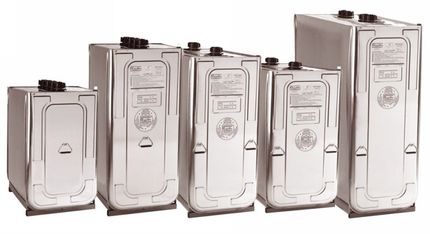
Roth Double-Wall Heating Oil Tanks

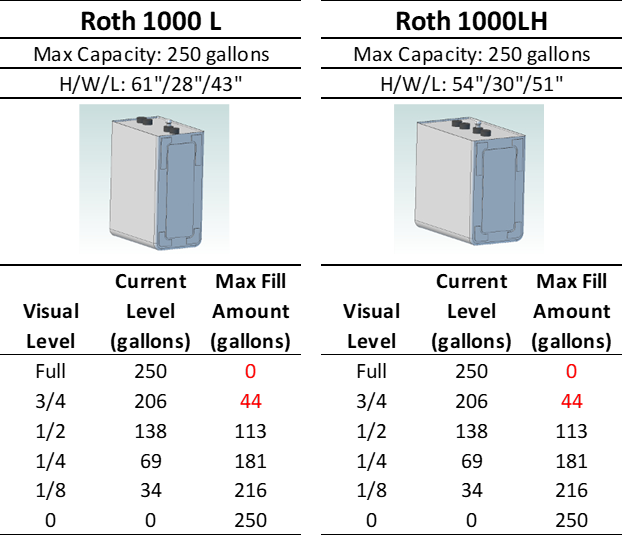
If you have a newer home, live near the water (i.e. the ocean), or have had your tank replaced in recent years, you may have a double-walled tank like the one shown above. These tanks feature an internal plastic tank enclosed in an outer metal shell. The most common variant of the Roth tank is the 1000L (275 gallons), which has a capacity of approximately 250 gallons.

Heating Oil Tank Capacity

Once you’ve identified which style home heating oil tank you have, the next step is to determine the overall capacity of the tank.

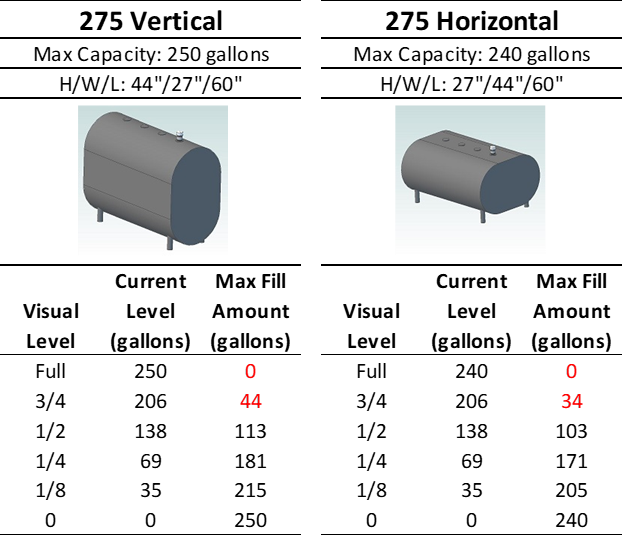
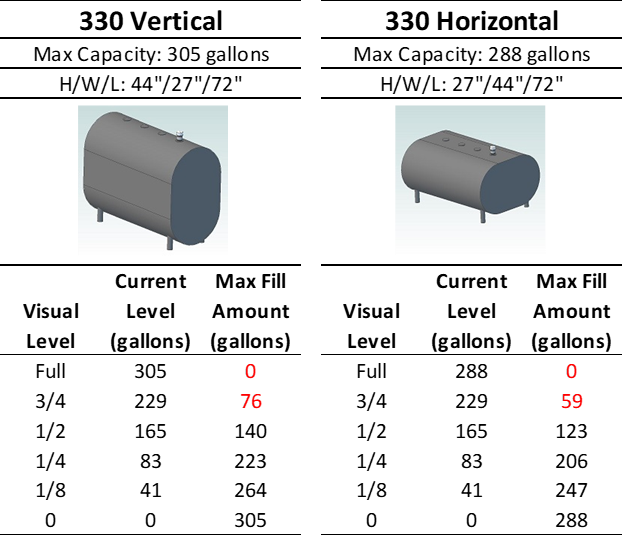
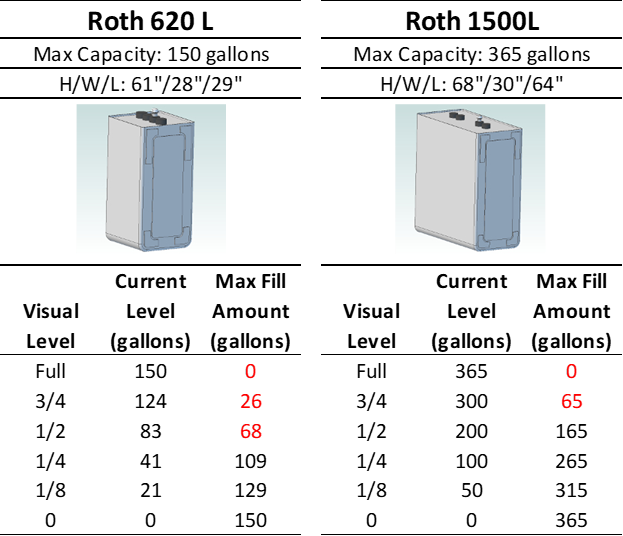
Tip: A 275 gallon oil tank DOES NOT hold 275 gallons – it actually holds between 240 and 250 gallons when full. A table of common tank capacities is shown at the bottom of this post.

The reason a tank does not hold the full amount has to do with two things: the vent alarm “whistle”, and the air space required at the top of the tank.

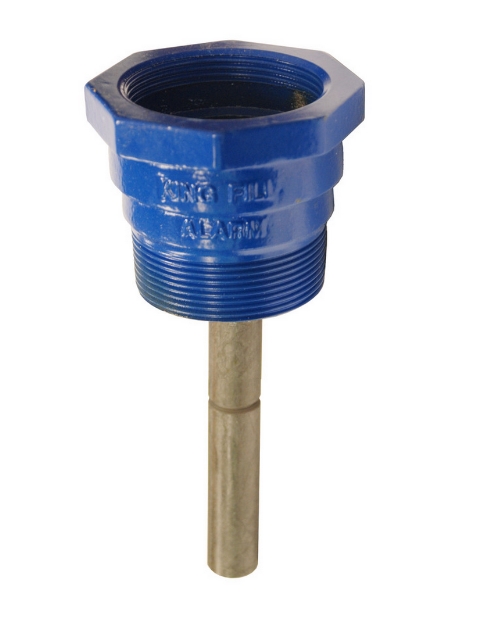
The Vent Alarm is a roughly 6” device that hangs down in the tank, positioned right under the vent pipe. As oil enters the tank, air is forced out of the tank through the vent pipe, causing the vent alarm to audibly whistle. The driver can hear this whistling sound from outside the house where the oil is pumped in. As the oil in the tank rises, it eventually touches this vent alarm whistle, causing it to stop making noise. At this point, the driver knows to stop pumping oil into the tank, as it is full. The whistle is designed to stop making noise when there’s approximately 6” of air remaining in the top of the tank. This way, it gives the driver a few seconds to shut the pump off without over filling the tank. It also allows the oil to expand as it warms up once it’s inside the house.

Heating Oil Vent Alarm “Whistle”

Your Current Level

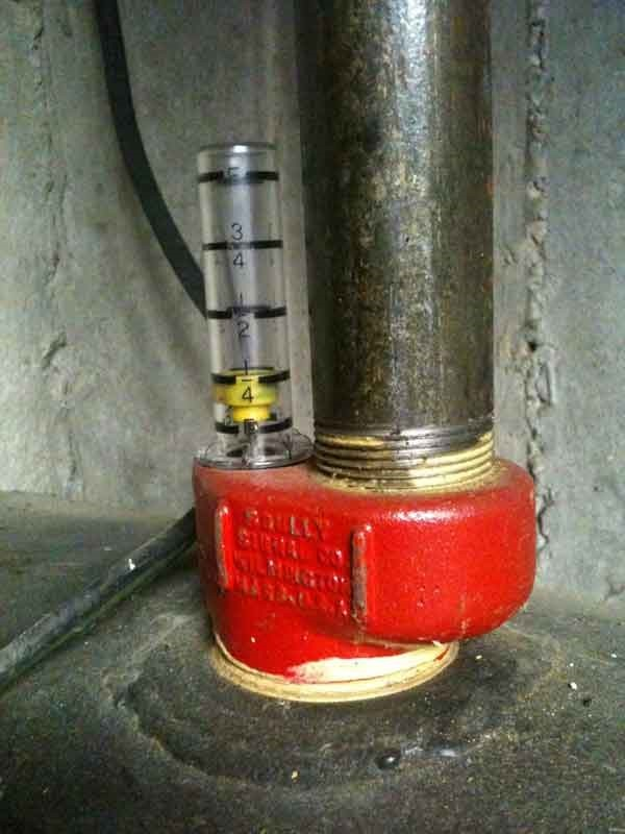
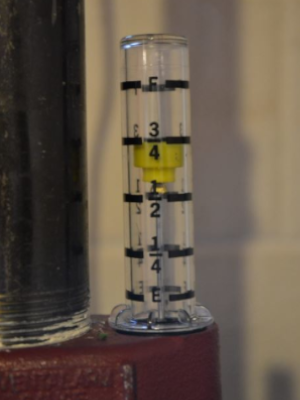
Now that you know your heating oil tank’s max capacity, you’ll need to figure out your current level. The easiest way to tell is to use a Smart Oil Gauge, which not only tells you to the nearest tenth of a gallon what’s in your heating oil tank, but will also show you how much oil you can have delivered at any given time. If you don’t have a Smart Oil Gauge, then you’ll need to refer to the float gauge on your tank. This will give you a ballpark reading of ¼, ½, ¾, etc. At the bottom of this post are approximate levels based on your tank style, and what the float gauge is reading. With this, you can see the maximum amount of oil you can fit in the tank. If you don’t have a float gauge or a Smart Oil Gauge, you will need to use a measuring stick and an oil tank chart – a time consuming and messy process!

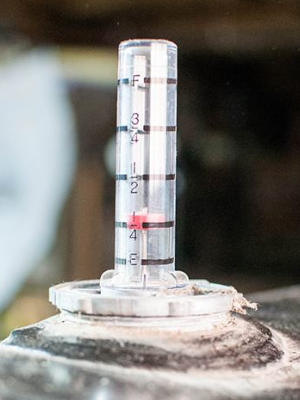
A Float Gauge at 1/4 Full

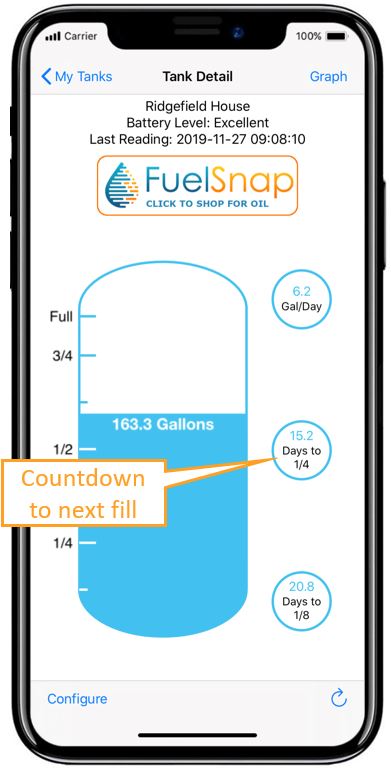
If your float gauge does not work, you should definitely consider installing a Smart Oil Gauge. Since it does not have any moving parts, it will not be subject to sludge buildup over time that typically causes the float gauges to fail. It will tell you from an app on your phone exactly how much oil is in the tank, helping you plan for your next delivery.

A Smart Oil Gauge Tells You Current Level and Days to Next Fill

With all this in mind, we’ve put together the guide below to determine how much oil can be delivered based on the current level in your particular tank.

Happy Heating,

Steve