
All Heating Oil Tanks have a tank gauge. This gauge will tell you how much oil is in your tank. Whether or not your gauge is a standard float gauge or a Smart Oil Gauge will also play into the gauge’s accuracy. Why is this? Well, a lot of float gauges can get bogged down and coated in oil, which can affect their overall accuracy. Now you might be wondering which tank gauges are the most accurate? Well, don’t worry because I’ll be going over all that here!
What is a Float Gauge and How Does it Work?
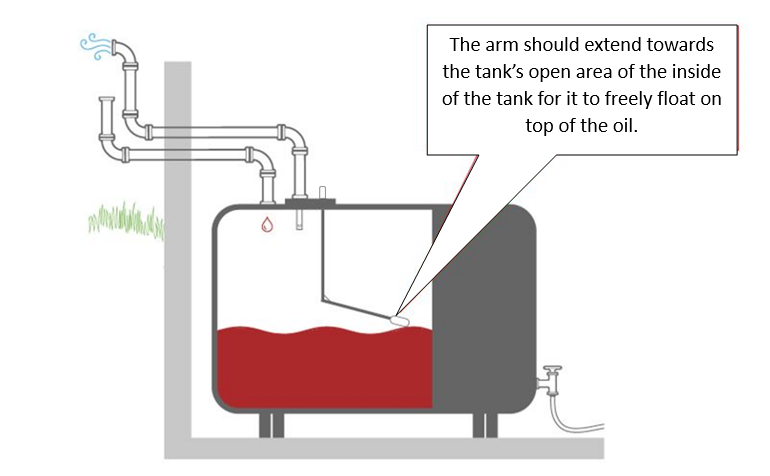
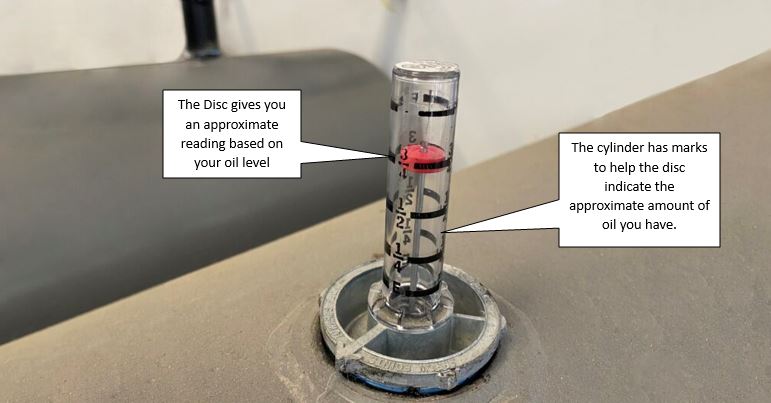
The float gauge is a very simple tank gauge to understand. Basically, it’s a metal arm with a bobber at the end and the bobber will tell you how much oil is in the tank. The metal float arm connects to a cylinder with a colorful disc at the end. The colorful disc will line up with the marks on the cylinder to show you how much oil is in the tank. For example these cylinders usually have empty, 1/4, 1/2, 3/4 and full tank marks. What displays depends on where the disc sits in the cylinder.
But as you use oil, you will slowly see your oil level go down. Meanwhile, when you get a fill-up, you will see the disc go up which will bring the reading on the cylinder to the full mark or even the 3/4 mark if you didn’t get a complete fill.
Reading Your Float Gauge
Reading the float gauge on your tank is relatively easy. The float arm connects to a colorful disc inside a plastic cylinder. Where the disc sits at depends on how much oil is in the tank. The bobber will sit on the surface of the oil, which is where you’ll find out how much oil you have in the tank.
But it’s important to note that float gauges are only an approximate reading. Float Gauges aren’t always completley accurate, especially the older that they get. On older float gauges, they’ll actually be less accurate because overtime, oil and sludge will coat the bobber causing it to read less than what’s really in the tank.
Float gauges also normally don’t read for specific tank sizes. This means that if your tank is a 275 gallon or a 330 gallon, the float will not know which size it’s reading for. So be sure to keep that in mind when you are using the float gauge and be mindful for what size tank you have.
If you know your tank size, then you’ll be able to better understand what the float gauge is reading. All float gauges will normally have marks on their cylinder for “Empty”, 1/4, 1/2. 3/4 and “Full”. How many gallons exactly this is, will have to be determined by a stick measurement and a tank graph chart. You can use our tank calculator by following this link.
An important rule to follow when using these tanks is Always Order at a Quarter Tank. This will ensure that you have enough heating oil in your tank by the time your next delivery arrives.
Float Gauge Accuracy
Unfortunately, float gauges are not very accurate in the long-term. There are a few reasons for this, but there are two major reasons for this:
Age of the Float Gauge
After several years of using the float gauge, it will have sludge begin to build up on the bobber. This will weigh down on the bobber and cause it to be inaccurate. The bobber also might get caught on the sludge build up on the bottom of the tank. That can cause the gauge to be inaccurate as it reaches the bottom of the tank.
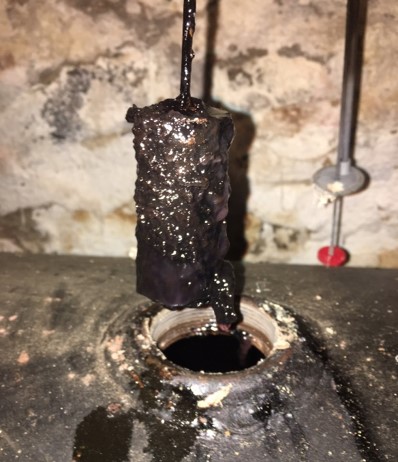
The bobber of the float gauge can get stuck on the bottom of the tank. However, it can also get stuck on the sides of the tank too. Overtime, the float gauge might move slightly in the tank, and what happens sometimes is the bobber of the float getting caught on the side of the tank.
Float Gauges aren’t aware of Tank Geometry
The arms of the float gauges are only meant to move up and down. Now because of this, they do not take the curvature of the tank into consideration. While the middle of the tank is straight up and down, the sides of the tank are curved. This means that there is actually less surface area in the tank than the float gauge might think. Due to this, once you start hitting the curved portions of the tank, the float will look like that you’re using a lot more oil than you actually are. But in actuality, there’s less oil within the bottom of the tank than you might think.
The Smart Oil Gauge
The Smart Oil Gauge is currently one of the best ways to monitor your heating oil tank. These devices are installed on top of your tank and operate off of an ultrasonic sensor. The ultrasonic sensor will bounce off the oil and go back up to the sensor to report. The nice thing about these devices is that they are able to accommodate for the curvature of the tank, unlike the float. This also means that if your tank is a specific size, you can program the Smart Oil Gauge to read for that tank size all by using a custom tank ID.
Tracking Your Usage with the Smart Oil Gauge
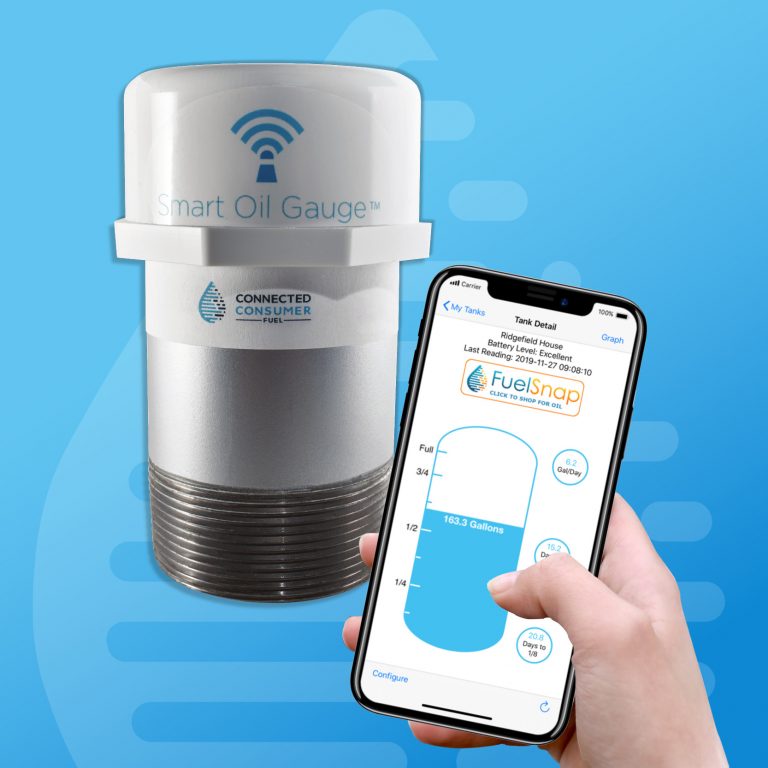
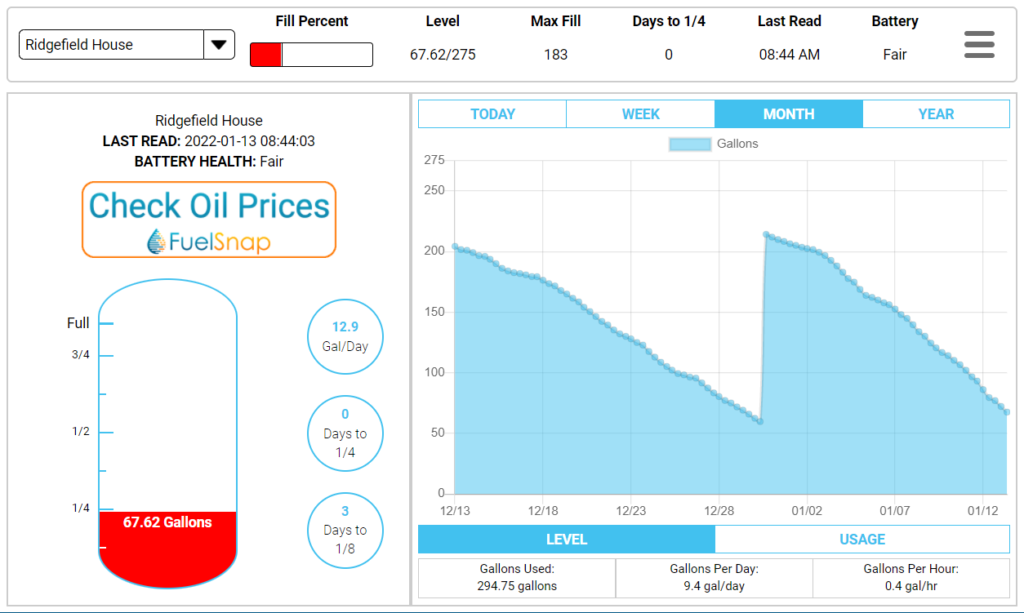
The Smart Oil Gauge is very useful and incredibly helpful. You’re able to track not only what your oil level is, but also your usage. Tracking your usage is very important for you to know when you need a delivery of heating oil and when you’ll need to order. The gauge will keep track of daily, weekly, monthly and yearly usage and level data. Here is just a small list of what exactly the gauge tracks:
- Oil Usage (Daily, Weekly, Monthly and Yearly)
- Days until 1/4 Tank
- Days until 1/8 Tank
- Receiving a Fill-Up
- Abnormally High Usage
- Total Gallons Used
The Accuracy of the Smart Oil Gauge
One of the most important things about the Smart Oil Gauge is it’s accuracy. The Gauge itself will read the level based on what size tank the gauge is setup for in the app. So upon setup of the gauge, it’s very important to understand what size tank you have. If your tank is a 275 gallon vertical tank, then the Smart Oil Gauge must be setup to read for that tank size or it will be inaccurate.
The most common tank sizes that the Smart Oil Gauge will be installed on are typically Granby 275 gallon, 330 Gallons and Roth 1000L tanks. Now it’s important that during setup of your Smart Oil Gauge that you select these as your tank sizes. Not doing this will cause the sensor to not be accurate when it is taking level readings.
Finally, if you are using the gauge on a Roth tank, then you MUST get the Roth Adapter. These adapters are required for Roth installation because without them, the gauge is not going to read properly and the signal will hit the fitting causing it to read full. The Smart Oil Gauge sends it’s signal in a cone shape. So without the special guide cone, the gauge will not be able to properly send the signal into the tank.
Standard vs Duo Smart Oil Gauge
Unlike the float, we offer two kinds of Smart Oil Gauges. They are the standard model and the Duo model. These devices are each a little different, but function similarly.
The standard Smart Oil Gauge is a single-sensor device. This device can only operate from 8″-72″. This is due to a slight sensitivity that the device has when the tank is full. When the tank is full, there isn’t enough room to send the signal properly. This can cause the gauge to read less oil than what’s actually in the tank after a delivery. We have an in-depth explanation about this on our website. I am providing a link to that here. Additionally, unlike the Duo, you cannot remove the boards from the gauge, as this will cause the device to be unable to communicate with the sensor.
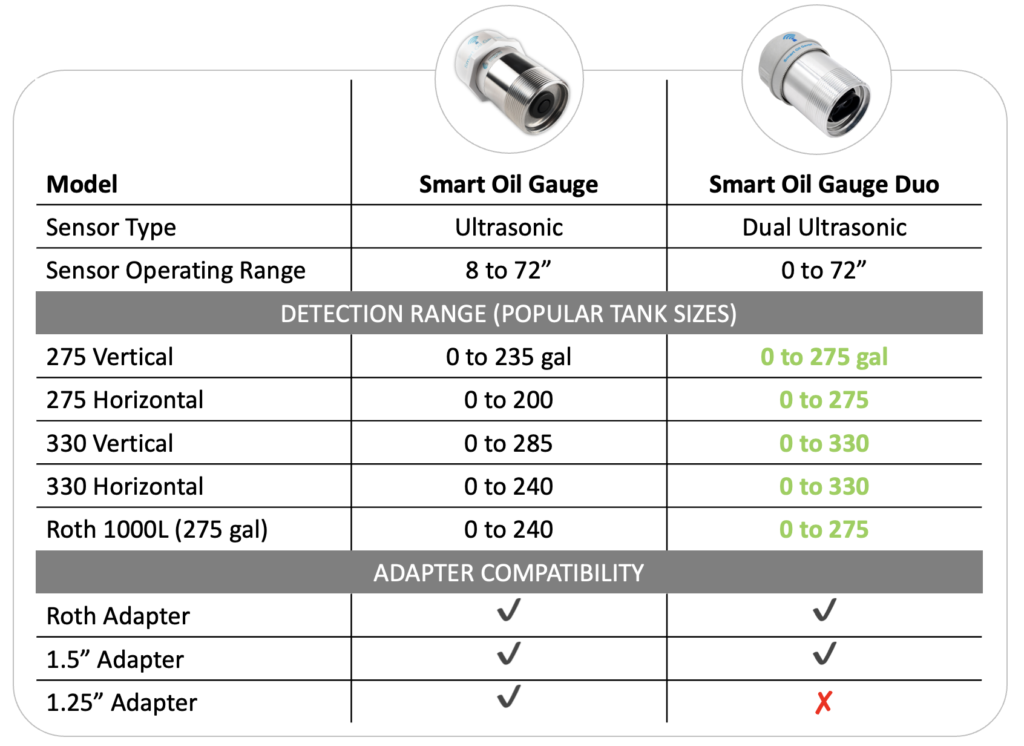
However, the Smart Oil Gauge Duo is currently our most accurate sensor. It has a larger operating range of 0-72″, unlike the standard model. This means that even after a fill-up, the device will be reading accurately. Additionally, you can take the interiors of the gauge out to troubleshoot in case you need to swap out batteries or update your WIFI credentials! If you’re interested on the differences between the two, you can read our article on their differences here.
Which Gauge Is More Accurate?
When comparing the two gauges together the Smart Oil Gauge is definitely the more accurate device. This is mostly due to the float becoming less accurate over time as it gets bogged down and coated in sludge and oil. Float gauges also can get their bobbers stuck on the sides or bottom of the tank which can cause it to not read correctly.
But the Smart Oil Gauge is very accurate. As long as it’s setup for the correct tank size, you’ll be able to know exactly how much oil is in your tank at any given moment! While the standard model has a little bit of a sensitivity at the top of the tank, the Duo doesn’t which makes it much more accurate than even the standard model! Just make sure that you either replace your float with this gauge or have an extra fitting to install it in!
Happy Heating,
Hunter